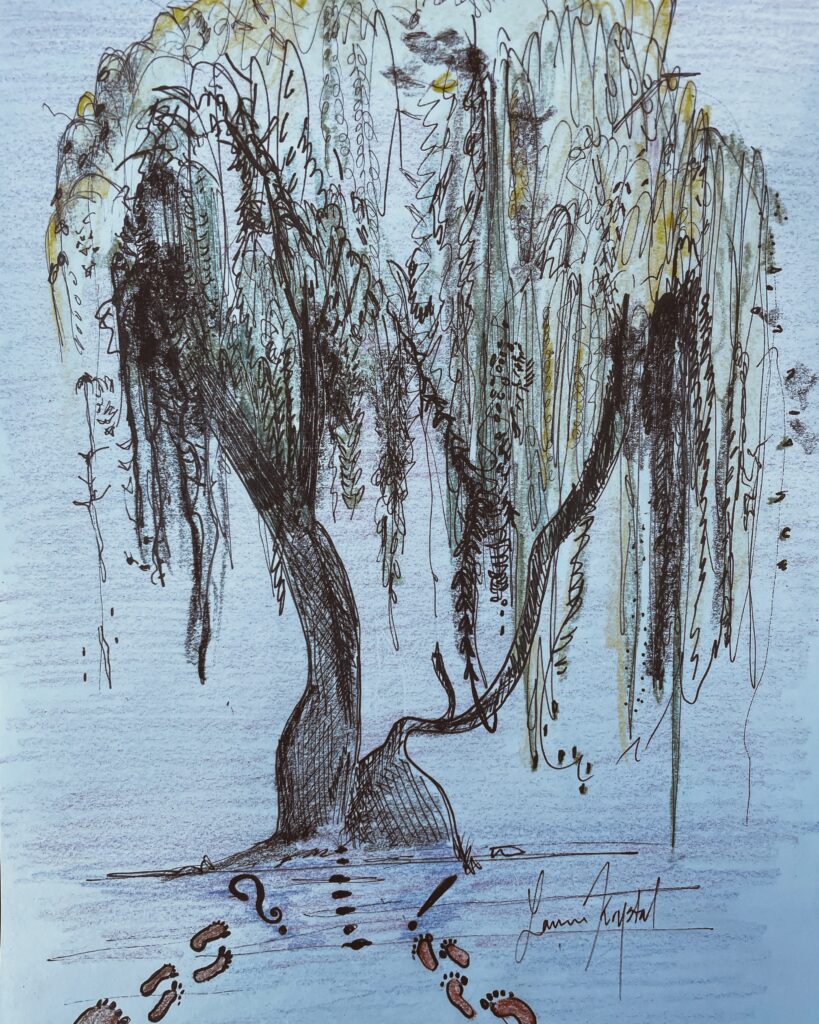
Weeping trees grow flexible branches that flow with the wind, create openings and change with the seasons. Pedagogical partnerships require flow, flexibility and movement to inspire transformation in teaching and learning. The image of the weeping tree is meant to capture this and encourage us to look towards the wisdom of natural beings as we seek change in our approach to building more joyful and meaningful connections in educational spaces.
quote and artwork by
Lauren Lattimore, Bryn Mawr College ’21
The Students as Learners and Teachers (SaLT) Program is the signature program of the Teaching and Learning Institute (TLI) at Bryn Mawr and Haveford Colleges. Student partners in the program are often referred to as student consultants, a name they chose for themselves. They partner with individual faculty and departments to create more inclusive and joyful teaching and spaces of learning.
History of SaLT
Conceptualized in 2006 and piloted in 2007 by Dr. Alison Cook-Sather with support from a grant from The Andrew W. Mellon Foundation, SaLT took as it first focus the support of faculty members at Bryn Mawr College and Haverford College working with students consultants of color to support the development of more culturally sustaining practices. Since its advent, SaLT, now funded by Bryn Mawr and Haverford Colleges, has supported more than 300 Bi-Co faculty and 200 Bi-Co students (many of them also multiple times) in partnerships focused on pedagogical and curricular development and revision.
The one-on-one, semester-long collaborations developed during the pilot phase of the program became the basic model for all partnerships through SaLT, which is now one of the longest-standing pedagogical partnership programs in the world. Most partnerships are between students and faculty, but other members of the community, such as librarians, have also partnered with students to explore and refine approaches to teaching and learning.
Since SaLT was launched in 2007, more than 70 institutions around the world, 40 located in the U.S., have adopted and designed partnership programs to fit their needs.